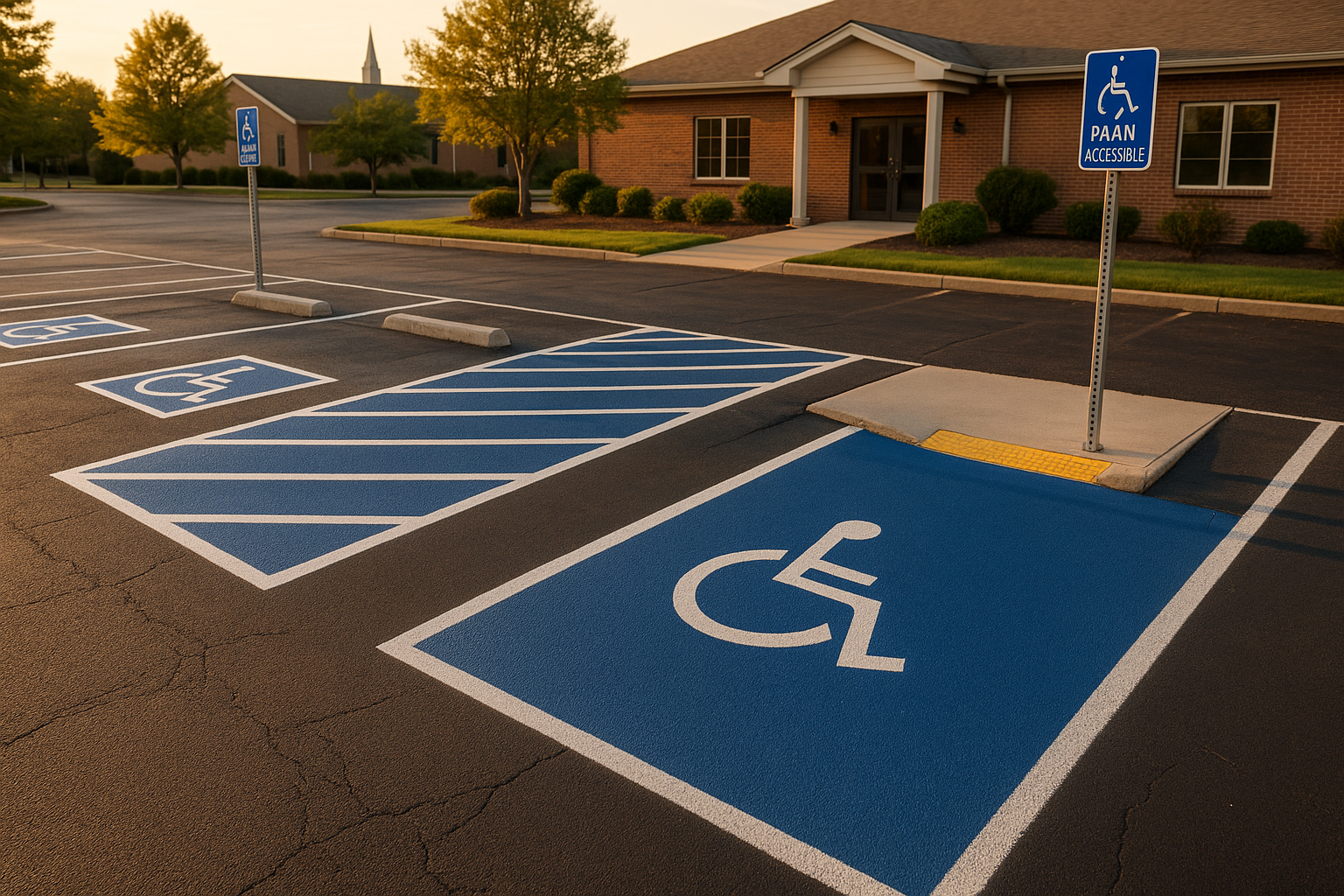
You know that sinking feeling when the inspector’s truck pulls up and you’re not 100% sure your lot is going to pass? Tom, who runs a medical office building over in Greenwood, told me he actually broke into a sweat last spring. He had five handicap spaces that looked more like modern art than legal parking—faded blue lines, a tilted sign post, and an access aisle that had been used as a pickup spot for the dumpster. The inspector was nice but firm: fix it or face a fine. Tom called us at PavementPros, and we had his lot sorted out in three nights, all while his tenants never noticed a thing.
But here’s the deal: ADA parking lot striping in Indianapolis isn’t just about avoiding tickets. It’s about making sure everyone who visits your property can actually get inside safely. Whether it’s a strip mall in Broad Ripple, a church in Fishers, or a big corporate campus in Carmel, the rules are pretty clear. And if you’re the one in charge, you might feel like everyone’s pointing fingers at you when something’s off. We get it. That’s why we handle the whole thing—striping, signs, layout, documentation—so you can breathe.
What Actually Goes Into ADA-Compliant Striping
First off, you can’t just paint a little blue square and call it a day. The 2010 ADA Standards (which Indianapolis and Marion County enforce) get real specific about widths, slopes, and signage. We start every job with a site walk. We’re out there with a tape measure, a notepad, and maybe a can of marking paint to lay out exactly where each stall and access aisle goes. For a typical lot, that means counting total spaces to figure out how many need to be accessible—one out of every six, roughly, with one van-accessible space for every six accessible ones. Miss that ratio and you’re already off the mark.
We check the pavement slope too. A stall that tilts more than 1:50 side-to-side? That’s a problem. Wheelchairs can roll, and it’s a trip hazard for folks with limited mobility. We’ll recommend grinding or patching if it’s bad, but often a simple layout tweak can work around a low spot. The whole point is that the lines, the access aisle, and the curb ramp all work together like a path. From the van-accessible parking spot right to the front door, no stairs, no cracks, no tilted nonsense.
Now, the actual markings: you’ve got options. For most Indy lots, we use a heavy-duty acrylic paint with reflective glass beads mixed in. That gives a crisp line during the day and bounces headlights back at night. On concrete, we’ll often use epoxy because it bonds better to that smooth surface. And the big blue handicap parking stencils? We use a thick template so the paint doesn’t bleed and the symbol stays sharp. In high-traffic spots—like a hospital lot that sees a thousand cars a day—thermoplastic striping is the champ. It’s melted on hot and holds up against salt, snowplows, and freeze-thaw cycles that turn cheaper paints into flaky messes by March.
Signs That Don’t Lean or Fade After One Winter
I can’t tell you how many times we’ve shown up to replace a sign that was either too low, peeling apart, or stuck on a 4x4 post that looked like a twig after a windstorm. ADA signage installation in Indianapolis has to be dead-on. The bottom of the sign needs to be at least 60 inches from the ground, and the post has to handle Midwest winds. We use galvanized steel posts set in concrete with anti-rotational mounts so the sign stays facing the right way. Reflective sheeting is a must—those glass beads in the paint are great, but the sign itself needs to shine when headlights hit it. If your lot is anywhere near a busy spot like the State Fairgrounds or Lucas Oil, you want that extra visibility.
We also pay attention to the wording. It’s got to say “Van Accessible” on those wider stalls, and have the International Symbol of Accessibility. Some older lots still have signs that just say “Handicap Parking” with a tiny emblem, but that won’t fly anymore. And if you have curb ramps with detectable warning panels—those bumpy yellow mats—they need to be in good shape and contrast with the walkway. We can install those too, keeping everything in one smooth job.
Working While You Sleep (So Your Tenants Don’t Complain)
Tom, the guy from earlier, had a big worry: “We can’t close the lot. We have patients with appointments all day.” That’s a common headache. So we do most of our ADA striping work at night or on weekends. For a medical building, we’ll cordon off a section at a time, paint it, let it cure, and move the barricades. By Monday morning, the whole lot looks new and no doctor calls to yell about parking. In retail centers, maybe we start at 9 p.m. Friday and wrap by 6 a.m. Saturday. We use water-based acrylics that dry fast, so even if it’s a bit humid, the lines are ready for cars within an hour or two. Epoxy takes longer, but we plan around that.
The freeze-thaw thing in Indiana? It’s real. Salt chews up cheap paint. That’s why we don’t skimp on surface prep. Cracked asphalt gets cleaned out and patched first. Concrete gets an etch or primer so the paint bites in. If you just sealcoated, we’ll wait at least 30 days—that’s the safe window so the sealer fully cures and the paint won’t peel off. Rush it and you’re throwing money away. I’ve seen lots where they striped right over fresh sealcoat and by spring it looked like a jigsaw puzzle.
Material Choices That Make Sense for Indy Lots
I get asked all the time: “What’s the best material for a lot that sees snowplows?” It really depends on your budget and traffic. Acrylic is the workhorse. It’s affordable, quick to apply, and with a good bead mix it’s reflective enough for most suburban lots. For a church in Zionsville or an apartment complex in Brownsburg, that’s usually the sweet spot. Epoxy is a step up—tougher against oil drips and salts, and it looks great on concrete. Healthcare facilities often lean that way because it stays clean.
Thermoplastic is the tank. It’s basically a hot-applied plastic that gets super hard and can last five years or more even with heavy plowing. The downside? It’s pricier and takes a little longer to install. But for huge distribution centers or lots around Plainfield that see a ton of truck traffic, it pays off. We’ll give you an honest recommendation based on what we see on the site walk, not just the most expensive option.
And here’s a little tip: after we stripe, we can leave you a bucket of glass beads and a small roller so you can refresh the reflectivity yourself if needed. It’s a cheap way to keep things bright between our scheduled maintenance visits.
Documentation That Saves Your Backside
One thing we always hand over is a simple packet: a scan of the layout drawing, the count of accessible spaces, photos of every stall and sign, and a note about which materials were used. If an inspector ever asks, you’ve got the proof. Some property managers get an ADA compliance audit for parking lots through a third party; we can work alongside them. But our documentation often satisfies the basic need. I’ve seen insurance claims denied because a property owner couldn’t prove they’d kept up with accessible parking signs in Indianapolis. Don’t be that guy.
What’s This Going to Cost Me? (Transparent Talk)
We price by the space, not by the hour. A typical quote includes: site walk, layout, striping and stencils for X number of ADA stalls, access aisle hashing, sign posts and signs (with concrete footers), and reflective beads. If you need detectable warning panels, curb painting, or line removal, that’s extra but clearly listed. The number of signs matters a lot—a small lot with two dedicated signs is way cheaper than a campus with 20. We don’t hide behind “call for pricing” games. After a 30-minute visit, you’ll get a line-by-line number in your email.
Can you reuse old posts? Sometimes, if they’re solid, straight, and the right height. But many older posts are too short or rusted through at the base. New ones aren’t expensive, and we warranty them against leaning.
Ready to Stop Worrying and Get Compliant?
If you’re staring at a lot that’s due for an update—or you’ve got an inspection notice—let’s talk. We’ll come out, measure everything, and draw up a plan that doesn’t disrupt your business. You’ll know exactly what you need, when we’ll do it, and how much it costs. No surprises, no hand-waving. Just grab a spot on our calendar through the quick form at /#quote. We cover all around Indianapolis, from Carmel down to Greenwood, Avon to New Pal. Whether it’s a tiny dental office lot or a big retail center, we’ve done it before. You’ll sleep better—trust me, Tom does.
Ready for a free lot assessment?
We walk the lot, photograph the problems, and hand you a written plan — no pressure, no obligation.