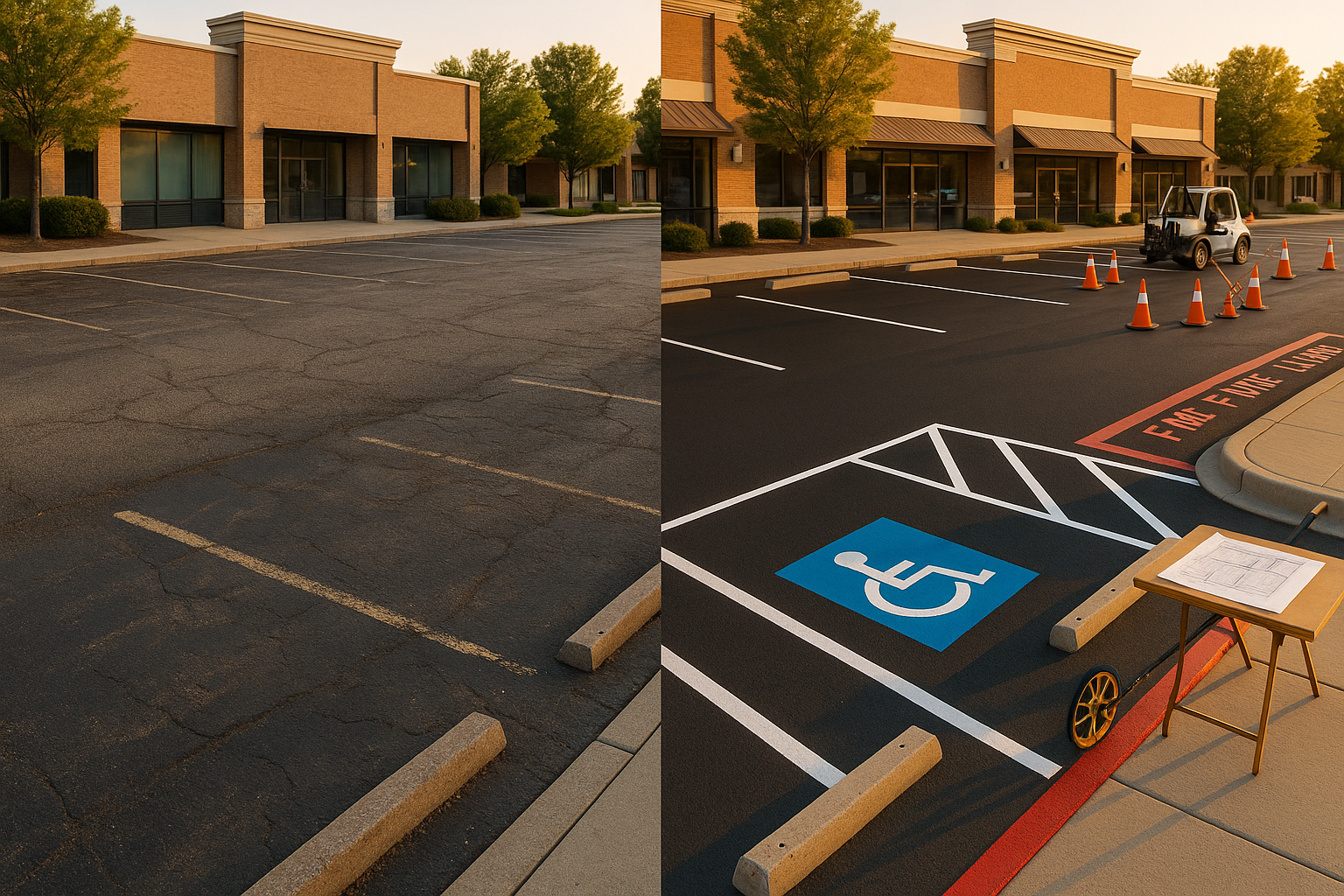
Last spring I got a call from a buddy who manages a small retail plaza over in Castleton. He sounded half-embarrassed, half-frustrated—his parking lot had turned into a free-for-all. The lines were so faded you couldn’t tell where one stall ended and the next began. People parked sideways, blocked each other in, and a near-miss with a delivery truck finally pushed him to act. He’d been putting off restriping because he thought the parking lot striping cost in Indianapolis would blow his budget. Turns out, it was way less than he expected—and a whole lot less than a lawsuit.
If your lot’s looking rough and you’re worried about the bill, let’s talk real numbers. Not inflated contractor talk—just what you can expect around Indy.
What Makes the Price Go Up or Down?
A bunch of things shift the final number. First, are you restriping over existing lines or starting from scratch? Restriping is cheaper because the crew just follows the old layout. A fresh layout takes more layout work (snapping chalk lines, measuring stall dimensions) so it costs more.
The number of stalls is the biggest driver. More stalls, more paint, more time. Simple.
Then there’s the paint. Most crews around here use fast-dry traffic paint—INDOT-approved stuff that sticks to asphalt and cures quick. Some property owners ask for thermoplastic (the thicker, melty stuff) but in central Indiana, with our freeze-thaw cycles and plowing, a high-quality traffic paint with glass beads for reflectivity holds up just fine and costs a lot less.
Stencils add up too: arrows, ADA wheelchair symbols, fire lane lettering. Each one takes time and a separate template.
If your pavement’s filthy or crumbling, prep work (sweeping, blowing, maybe spot cleaning) gets folded into the price. And if you need curb painting, wheel stops, or new signs—those have their own costs. (For a deeper dive, check out our parking lot striping cost breakdown.)
Ballpark Numbers: What You Might Pay Around Indy
These aren’t bids—just rough ranges so you can plan. Every job needs an on-site walk to pin down exact counts.
- Restriping a standard stall (straight, 90°): $5–$8 per stall.
- New layout from scratch: $10–$20 per stall.
- Arrows: $20–$35 each.
- ADA wheelchair symbols: $35–$75 each (blue paint, the whole thing).
- Curb or fire lane painting: $1.00–$2.50 per linear foot.
- Wheel stops, installed: $55–$95 each.
- ADA sign with post and install: $175–$300 per set.
- Mobilization (getting the crew and equipment to you): $150–$350, depending how far you are from our shop.
- Night or rush work: tack on 10–20%.
Some real-world scenarios:
- A small church lot in Irvington with 45 stalls, restripe only: about $400–$600.
- A neighborhood retail center in Greenwood with 130 stalls, new layout after a fresh sealcoat: $2,500–$3,500.
- A medical office in Fishers that needs ADA updates, curb painting, and a few new signs: $1,500–$2,200.
Again, these are guesses. Until we measure your lot and count every line and stencil, we can’t give a fixed number.
ADA and Fire Lanes: The Stuff You Can’t Skip
Getting sued over non-compliant parking is way more expensive than restriping. In Indiana, we follow the 2010 ADA Standards. That means the right number of accessible stalls (based on total spaces), plus van-accessible ones with that 8-foot access aisle. Signage has to be at the right height, and the lot needs proper slope.
Fire lanes are another beast. In Marion County, the local fire authority decides where you need the red curb and “FIRE LANE NO PARKING” stencils. If you’re not sure, we help coordinate that. We’ve seen too many owners get fines because they let the old markings disappear. A quick tip: if your fire lane paint is flaking, get it fixed before the next inspection.
We tie all this into a measured layout plan that you can approve before any paint hits the pavement. That way, you know exactly how many ADA stalls you’re getting and where—no surprises. (Our ADA requirements guide spells out the nitty-gritty if you want to read up.)
When Can You Get It Done? (And How Fast)
In Indianapolis, striping season runs roughly April through October. Temps need to be 45–50°F and rising, with dry pavement. If you call in March, we might have to wait for a warm stretch.
The good news: fast-dry paint means your lot can reopen in 30–60 minutes on a sunny summer day. On cool, damp mornings, give it a couple hours. We often phase the work—block off one section, let it dry, then move the cars over. Businesses in places like Broad Ripple or Speedway need that kind of flexibility, and we’re used to working around delivery schedules and lunch rushes.
Smart Ways to Keep the Bill Down
Bundle work. If you’re due for sealcoating, get the stripes done right after—you’ll save on mobilization because the crew’s already there. (See our take on sealcoating vs. doing nothing.)
Have a parking plan. Move cars to one side the night before, or get tenants to park elsewhere for the morning. The less time we spend shuffling vehicles, the less you pay.
Get the layout approved fast. If you drag your feet on approving the plan, we might have to reschedule, and that can add costs.
And if you’ve got multiple properties—say a strip mall in Avon and an office in Plainfield—let us quote them together. One trip, one setup fee, two fresh lots.
The Guys You Should Avoid
I’ve heard horror stories: a contractor quotes $2 a stall, shows up with watered-down paint, and the lines vanish by Thanksgiving. Or they skip prep, paint over dirt and gravel, and the paint peels off in sheets. Cheap bids usually mean thin paint, no layout, no ADA knowledge, and no plan for keeping your lot open.
Also, never trust a quote that’s just an hourly rate with no line count. You want an itemized list: x number of stalls, y arrows, z feet of curb. Period.
If they can’t tell you how they’ll handle barricades and tracking prevention—walk away.
How We Handle It at PavementPros
We’re not the flashy guys. We’re the ones who come out, walk your lot with a measuring wheel, and sketch a layout that makes sense for traffic flow and code. Then we send you a fixed, itemized quote. No surprise fees.
We phase the work so you stay open, we use INDOT-approved paints, and we clean the surface before we paint. After we finish, we do a walk-through with you and hand over a plan set for your records.
If you’re ready to stop worrying about fading lines and angry tenants, book a no-obligation site assessment. We’ll come out, measure everything, and give you a straight number—no fluff, no pressure.
Quick Answers You Might Need
How long do the stripes last around here? With our freeze-thaw cycles and plowing, expect 2–3 years. Sealcoating every few years helps.
Can you work nights? Sure. It costs a bit more, but we do it.
What if it rains on the schedule? We reschedule at no extra charge. We watch the radar like hawks.
Do I need permits for ADA or fire lane markings? Not usually for restriping, but fire lane specs can change. We help you check with the local fire marshal.
Ready for a free lot assessment?
We walk the lot, photograph the problems, and hand you a written plan — no pressure, no obligation.