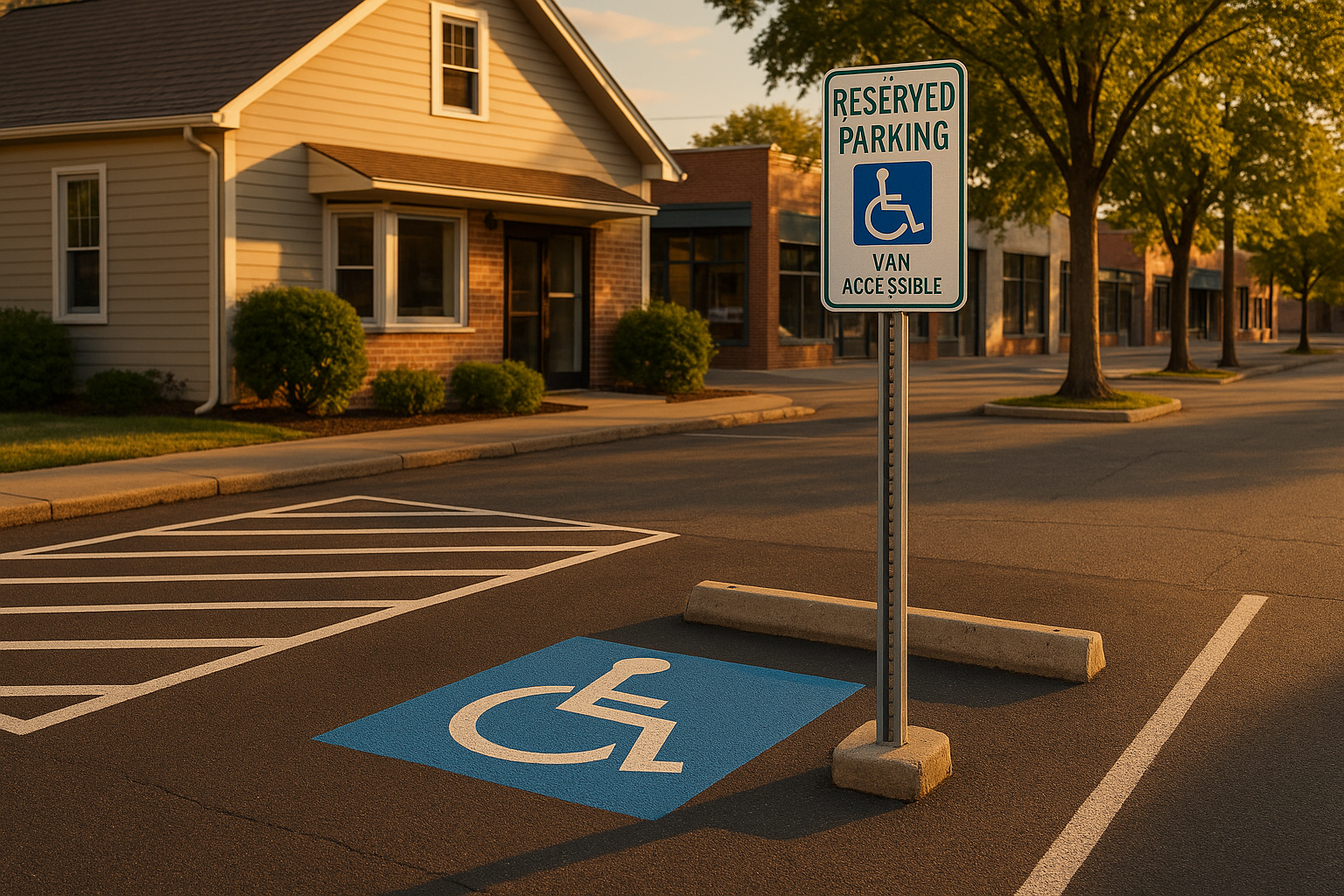
Last fall, a dentist over in Broad Ripple called me, almost in a panic. One of his patients with a wheelchair had a terrible time just getting into the building because the van-accessible spot was blocked by a new landscaping feature, and the sign had faded so badly it was pretty much invisible. He got a polite but firm letter from the city. He thought he was covered—he had a blue sign up!—but the details were all wrong. That’s the thing about ada parking compliance indianapolis: it’s the small stuff that trips you up.
We see this all the time. A business owner slaps up a sign they bought at the hardware store, stripes what looks like a wider spot, and figures they’re good. Then an inspector or—worse—a customer with a disability points out the signs are too low, the aisle is too narrow, or the whole space is on a slope steep enough to roll a wheelchair right into traffic.
That’s where we come in. We’re not just a parking lot signage contractor Indianapolis trusts; we’re the crew that actually listens to why you need it fixed and walks you through every step without making you feel dumb.
Get a Compliance Check (Before Someone Else Notices)
A lot of property managers don’t know exactly how many accessible spaces they need. Over in Fishers, a church we worked with had six van spaces when the code only required two—nice gesture, but they’d crammed them so close together that the access aisles overlapped. Not compliant, and nobody could use them anyway.
We start every job with a parking lot ADA compliance audit. I’ll walk the whole site with a clipboard and a camera, measuring slopes, counting stalls, checking sign heights, and tracing the path from each accessible spot to the nearest entrance. You get photos, notes, and a simple sketch that shows exactly what needs to change.
And no, you don’t have to shut down. We can do this during business hours without anyone noticing—more on that later.
Why a Simple Sign Isn’t Always Enough
You’d be amazed how often we see a sign that says “Handicap Parking” but misses the MUTCD R7-8 parking sign details. The feds are picky: the sign has to say “Reserved Parking” with the ISA symbol, and below it, a “Van Accessible” plaque if it’s a van space. Bottom of the sign? Must be at least 60 inches off the ground. Not 58. Not 64. Sixty. That van accessible parking sign height rule trips up a ton of well-meaning folks.
We install ADA parking signs Indianapolis businesses can count on. The panels are .080 aluminum with high-intensity prismatic sheeting—basically, they’ll still throw back headlights years from now even if a snowplow spits slush at them all winter. The posts? Galvanized and breakaway. If a car clips one, the post snaps at the base instead of bending your bumper or hurting someone. We set ’em in concrete footers below frost depth so they don’t heave when the ground freezes.
A little extra protection never hurts. Adding a few wheel stops or bumper blocks keeps cars from nudging your sign posts or blocking the access aisle. In places like Castleton or near Keystone, where tight lots see a lot of novice parkers, that’s cheap insurance.
The Nitty-Gritty of Accessible Parking Layouts
Here’s where most good intentions go sideways. An accessible parking layout design isn’t just “make it wider.” The 2010 ADA Standards spell out geometry that’s meant to work for cars and vans, side-loading lifts, and people who transfer from a seat:
- Standard car spaces: 8 feet wide, with a 5-foot access aisle on the passenger side (or shared between two spots).
- Van-accessible spaces: 11 feet wide with that same 5-foot aisle, or an 8-foot space with an 8-foot aisle (choice depends on your lot’s shape). Those aisles have to be marked with diagonal hatching so nobody parks there.
And the whole thing—space plus aisle—can’t slope more than 1:48 (that’s 2% grade) in any direction. A ADA slope 1:48 parking check means I’m on my hands and knees with a 4-foot level and a tape measure, especially on older asphalt. In Speedway or Southport, where lots might be 30 years old, we often find low spots right where the car door would open. That’s a tripping hazard and a drainage nightmare. Sometimes we can patch it; other times we need to repair the asphalt before we strike a line.
How many spaces do you need? The table in the code is based on total parking spots. A small medical office in Greenwood with a 25-spot lot typically needs one van-accessible space plus one standard accessible space. A big-box store in Plainfield with 400 spots might need eight or nine, with two of those being van-accessible. We’ll give you the exact numbers based on your lot, not a cookie-cutter guess.
Striping That Holds Up to Indiana Winters
Snowplow blades, road salt, freeze-thaw cycles—they chew up paint like nothing. So we don’t use the cheap stuff. For ADA striping Indianapolis lots need long-term, we offer three material tiers:
- Premium traffic paint with reflective beads: good for a couple years on low-traffic lots.
- MMA (methyl methacrylate): hardens into a plastic-like layer, great for high-wear areas and is snowplow-resistant.
- Preformed thermoplastic: we heat it in place so it fuses to the asphalt. The white ISA symbol and the blue background stay crisp, and the hatching doesn’t fade into a gray blob after one winter.
Before any of that goes down, we pressure wash the pavement and let it dry thoroughly. If the surface is gritty or damp, nothing sticks. Spring and early fall give us the best temps for application—lower humidity, warm asphalt, no threat of rain popping up mid-job. We can work in winter if we have to, but it takes extra curing time and heaters.
While we’re out there, adding some bright curb painting and traffic flow arrows goes a long way. In a shopping center parking lot re-striping Indianapolis crews often skip curbs, but painting the noses of islands and adding directional arrows helps people naturally flow toward the accessible stalls instead of driving in circles.
How We Keep Your Lot Open (Mostly)
You can’t afford to shut down parking during business hours. We get it. Our crews are pros at phasing: we’ll section off, say, the far row of stalls on a Tuesday morning, complete all the striping and sign installation there, then move to the next section while your tenants use the finished ones. We use cones, barricades, and clear signage so visitors aren’t confused. In busy spots like Downtown or Mass Ave near event days, we’ll shift the heavy work to early mornings or weekends.
Accessible parking requirements Indiana law enforces don’t pause during construction. We maintain at least one van-accessible path to the building at all times. If we have to temporarily relocate an accessible space, we put up temporary signs and mark a compliant temporary route.
For HOAs and Multifamily Properties
If you’re on an HOA board in Lawrence or near Castleton, you’ve probably got a mix of residents and visitors using the same lot. HOA parking compliance Indianapolis calls for clear, separate signage for visitor accessible spots versus resident-only ones—otherwise you get squatting. We can help you add “Resident Only” sub-signs and re-stripe to keep those visitor spots open.
What Happens After We’re Done
You’ll get a simple packet: after photos, an as-built map with dimensions and counts noted, and a sheet listing sign types and mounting heights. Useful for your records, and handy if an inspector ever asks. Then you can forget about it for a few years.
If you’re ready to stop worrying about whether your lot will pass muster, let’s do a walk. No jargon, no upsells—just a clear look at what you’ve got and what it’ll take to bring you into ada parking compliance indianapolis both the law and common sense demand.
Request your on-site assessment and get an itemized quote here.
Ready for a free lot assessment?
We walk the lot, photograph the problems, and hand you a written plan — no pressure, no obligation.