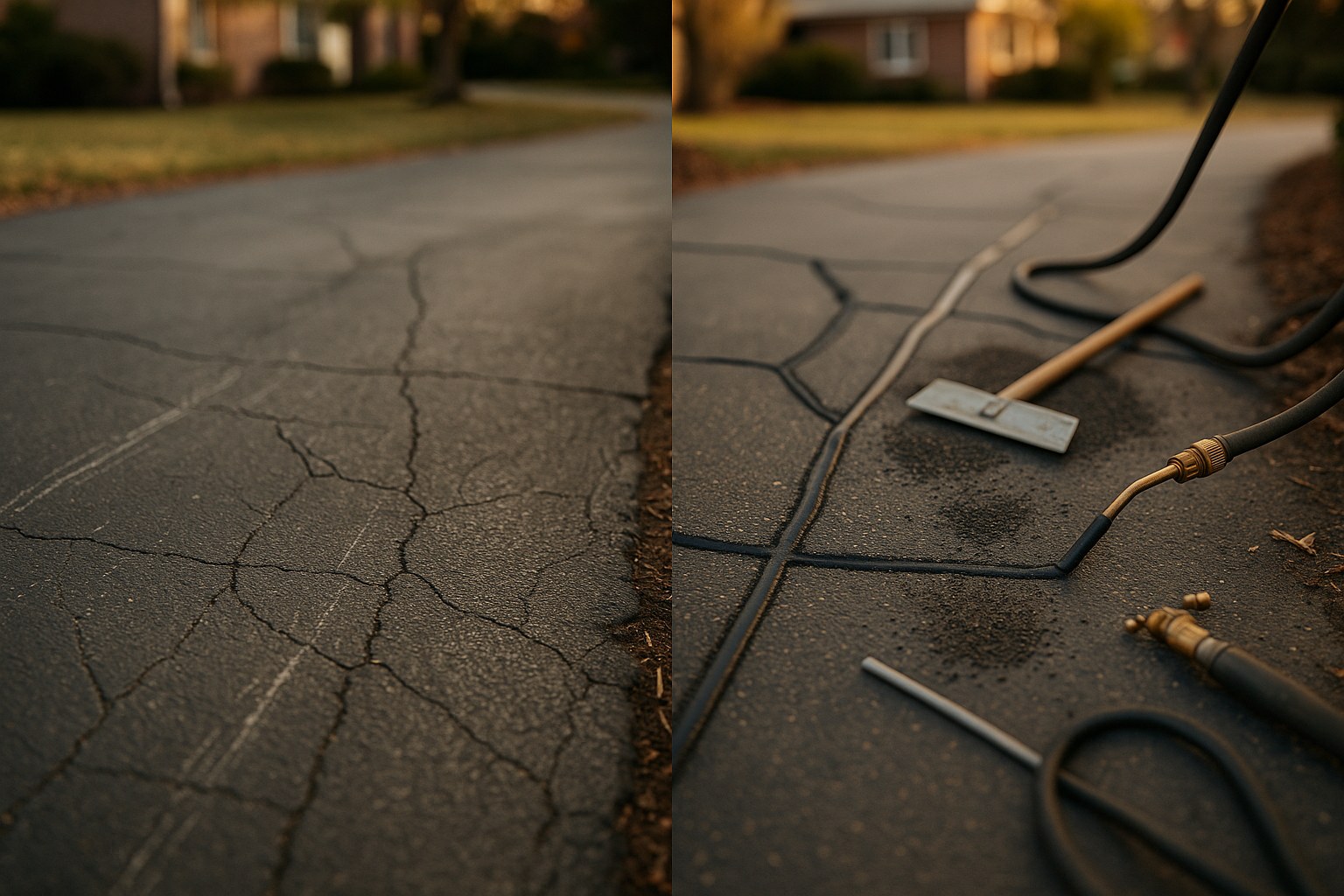
Last April, my neighbor Mike in Broad Ripple stared at his driveway like it had personally insulted him. The winter had carved a spiderweb of cracks into the asphalt, and he was convinced the whole thing was going to crumble into a gravel pit by summer. It’s a scene I see over and over here in Indianapolis—freeze-thaw cycles do a number on pavement. Mike thought he needed a full replacement, but after a quick inspection, it turned out most of those cracks just needed proper filling. That’s the thing about asphalt: small cracks are no big deal if you catch them early. But ignore them, and water gets in, freezes, expands, and pops the surface apart. Next thing you know, you’re patching potholes or worse.
At PavementPros, we’ve helped a lot of Mikes over the years. We do asphalt crack filling in Indianapolis the way it should be done—with quality materials, clear communication, and a plan that fits your property’s actual needs. Not a one-size-fits-all squeeze and dash.
Why Indianapolis Pavement Gets Cracks So Fast
Blame our Midwest weather. Central Indiana sees some of the most aggressive freeze-thaw cycles in the country. Water sneaks into the tiniest hairline crack, then winter hits and that water freezes, expanding by about 9%. That expansion widens the crack, lets more water in, and the cycle repeats all season long. By spring, you’ve got a mess. And if your driveway or lot sits on our classic clay soil, minor drainage issues can make cracks appear faster along the edges and seams.
De-icing salts and snowplow blades don’t help either. You can’t avoid them if you live in Indy—especially in neighborhoods like Meridian-Kessler or Geist, or busy lots near I-465. Salts accelerate surface wear, and plows can catch on existing cracks and snap off little chunks of asphalt. A crack that could have been sealed for a few bucks becomes a pothole that requires a full patch—or worse, base failure.
How We Do Asphalt Crack Filling (The Right Way)
Our process isn’t just squirt-and-go. It starts with an on-site assessment where we walk your whole pavement with you—driveway, parking lot, whatever—and map out the cracks by type, width, and length. Not everything gets filled the same way. Hairline cracks might need routing to open them up and give the sealer good adhesion. Wider, deeper cracks often need a backer rod or sand fill so the hot rubber doesn’t sink and collapse. And fatigue cracks (those alligator patterns)? Those aren’t crack-fill candidates; we’ll be straight with you and say you need patching or a more extensive repair.
For the actual crack filling, we use hot-applied, rubberized sealant that meets ASTM D6690 specs. It stays flexible through wild temperature swings, so it stretches and moves with the pavement instead of popping loose. Before we ever touch the wand, we clean every crack—pull out weeds and grass, blow out debris and moisture with compressed air, and sometimes use a heat lance to get the surface bone-dry. Then we apply the sealer at the right temperature, tool it with a squeegee for a neat line, and blot it with fine aggregate so you’re not tracking black gunk onto your garage floor or customer’s carpets.
We schedule around Indianapolis weather, which means dry days with pavement temps roughly between 40° and 90°F. In practice, the sweet spot is usually April through early June and then late August through October. We watch the forecast like hawks—pop-up summer storms and high humidity can push us a day, but we always communicate clearly.
What to Expect After Your Crack Filling Service
Residential driveways are typically ready to use the same day, a few hours after we finish. Commercial lots often need staged work so business can keep humming—we’ll work with you to minimize downtime. You might notice the sealed lines look a little glossy at first, but they’ll flatten to a dark charcoal once the aggregate sits in. Over time they’ll blend closer to the asphalt color, though a slight texture difference is normal.
Crack Filling vs. Sealcoating: What’s the Difference?
This is the number one thing folks mix up. Crack filling is a targeted repair—sealing individual cracks to keep water out. Sealcoating is the broad protective coating that goes over your whole paved surface to shield it from UV rays, oxidation, and spills. Ideally, you crack fill first, let the sealer cure (usually 24–48 hours, but we’ll give you a specific window), then sealcoat for a uniform look and extra defense. If you’re thinking about a full maintenance plan, check out our thoughts on how often a commercial lot really needs sealcoating.
Questions We Get from Indianapolis Homeowners
“Will the repaired cracks be ugly or shiny?” They’ll be darker than aged asphalt for a while, but not glaring. The sand blotting tones down any unnatural gloss, and after a few weeks of sun and traffic, they blend in. Most people tell us it looks cleaner than having a bunch of open, crumbling gaps.
“Do you route every crack? Why or why not?” Not always. Routing is great for structural cracks that need a bigger reservoir for the sealant to bond and flex. But for shallow, stable cracks, routing can do more harm than good. We decide case by case, not by a generic playbook.
“How do you price?” We measure by linear foot, grouped by crack width. A hairline crack costs less per foot than a deep, wide one that needs backer rod. You get an itemized count and a simple written scope before any work starts—no surprises.
“What if rain shows up on my service day?” If the pavement isn’t dry to the touch, we wait. We’re always checking moisture levels on-site, even if the sun’s out. A bit of dampness can ruin adhesion. We’ll reschedule—typically within a day or two—and keep you posted.
“Can you work within HOA rules?” Absolutely. Lots of HOAs in Carmel, Fishers, and Zionsville have specific schedules or aesthetic expectations. We’re used to coordinating with property managers and can phase work to match neighborhood timelines.
“Will de-icing salts or snowplows ruin the work?” No repair is indestructible, but a properly sealed crack is much more resistant to salt intrusion than an open one. Plow blades can still catch on raised edges, which is why we tool the sealant flush. In the long run, regular maintenance is cheaper and less disruptive than reactive fixes.
Ready to Protect Your Driveway or Parking Lot?
If you’re anywhere around Indianapolis—downtown, Broad Ripple, Irvington, or out in Greenwood, Avon, or Brownsburg—give us a shout. We’ll come out, walk your property, measure everything up, and hand you an honest plan with clear numbers. No pushy sales talk. Just a straightforward way to keep your asphalt from turning into a pothole farm.
Schedule an on-site assessment and get a detailed, no-nonsense quote today.
Ready for a free lot assessment?
We walk the lot, photograph the problems, and hand you a written plan — no pressure, no obligation.