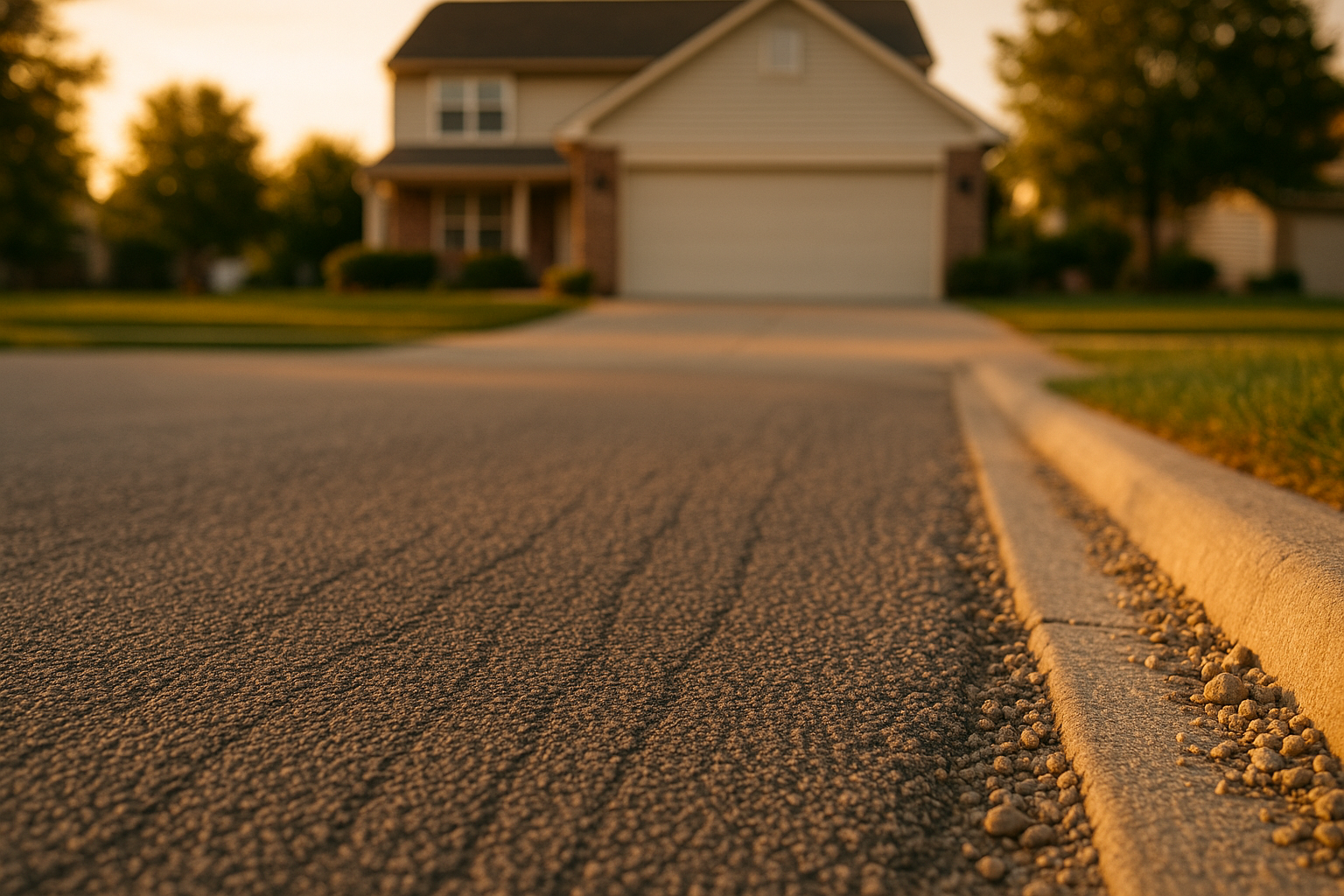
Last spring, my neighbor in Broad Ripple stared at his driveway like it had betrayed him. Just a year old, and already a spiderweb of cracks had appeared over the winter. He’d shoveled snow, thrown down some ice melt, and figured asphalt was tough enough to handle Indiana weather. But the freeze-thaw cycle had other plans.
If you’ve asked “why does asphalt crack” after seeing your parking lot or driveway look worse for wear each spring, you’re not alone. Here in Indianapolis and the surrounding suburbs—Carmel, Fishers, Zionsville, you name it—our climate is brutal on pavement. Let’s break down exactly what’s happening and, more importantly, what you can do to stop it from getting worse.
The Freeze-Thaw Beatdown
Asphalt is a lot like a rubber band. It stretches when it’s hot and shrinks when it’s cold. But unlike a rubber band, it can only take so much pulling before it snaps—or in this case, cracks. In summer, the sun heats up the black surface, and the pavement expands. Then winter hits, temps drop, and it contracts. That back-and-forth stress is what starts those first hairline fractures, usually running across your driveway or along its length.
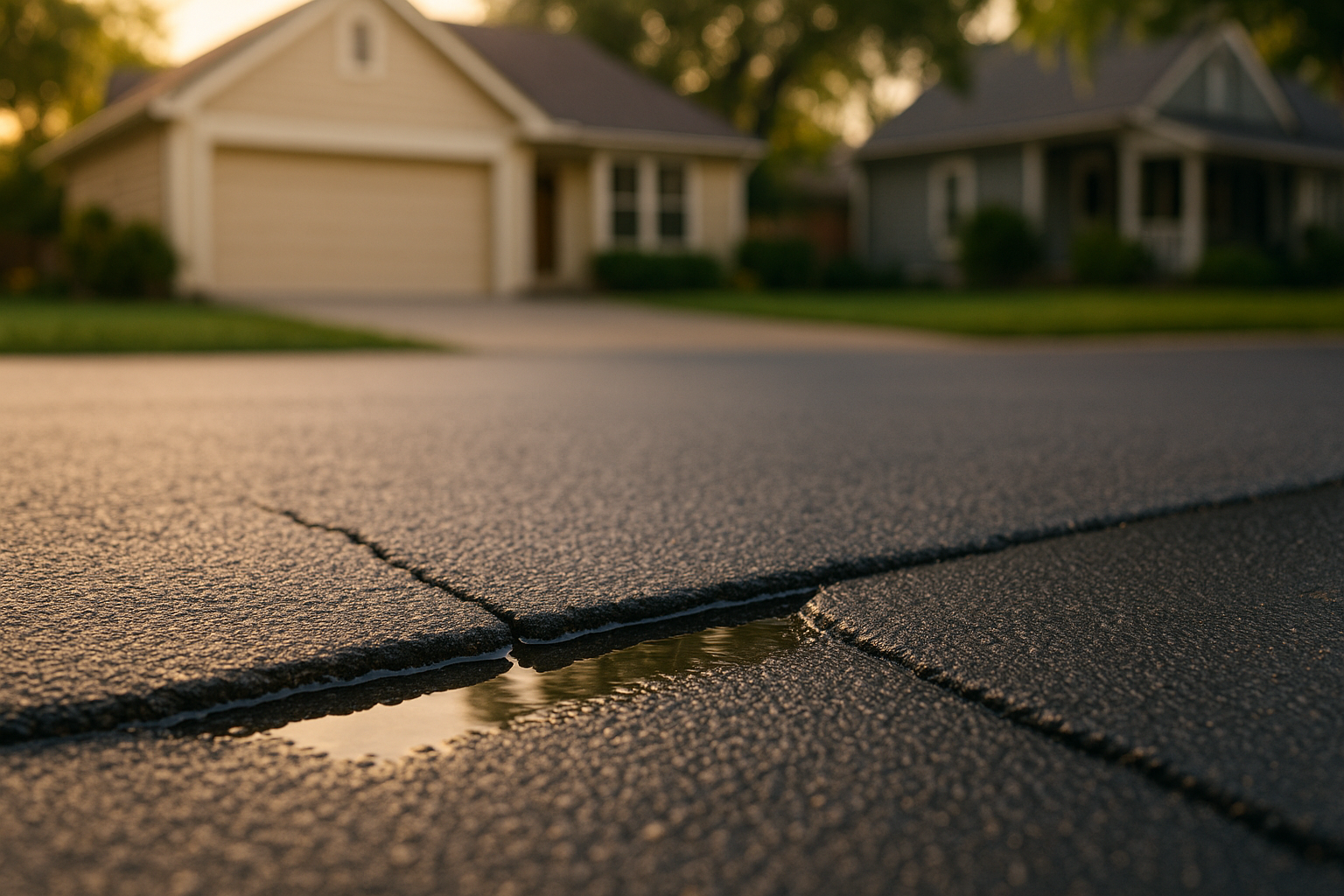
Things get ugly when water joins the party. Melted snow or a spring rain trickles into those tiny cracks. At night, the water freezes, expanding by about 9%. That expansion acts like a wedge, prying the crack wider. Do that a few dozen times over a typical Indianapolis winter, and a hairline becomes a gap wide enough to lose a key in. And let’s be real: our clay-heavy soil around here holds moisture like a sponge, making the ground under your pavement shift and swell with every wet-dry-freeze-thaw cycle. I’ve seen driveways in Westfield where the downspout dumps water right onto the edge—those spots always crack first.
Water: The Real Enemy
If there’s one thing to take away, it’s that water is public enemy number one for asphalt. Once moisture gets past the surface, it doesn’t just widen cracks—it goes after the base. Your pavement sits on layers of compacted stone and soil. When water sneaks in, it washes away the fine particles that lock everything together. The base loses support, and suddenly you’ve got a section that sinks or flexes every time a car rolls over it. That’s when you see alligator cracking—those interconnected cracks that look like a reptile’s back—and eventually, potholes.
Spring rains are especially sneaky around here. Flat commercial lots in Greenwood or Noblesville can hold water for days if the drainage isn’t right. All that standing water seeps in through any opening it can find, supercharging the damage. And once the base is compromised, filling the crack on top is like putting a band-aid on a broken bone. You need patching or full-depth repair. (We cover that in more detail over here.)
Sun, Salt, and Surprising Stressors
Freeze-thaw and water get most of the blame, but the sun is a quiet culprit too. Ultraviolet rays slowly cook the asphalt binder—the sticky tar-like part that holds the rocks together. Over time, it oxidizes, turns brittle, and loses its flexibility. You can see it happening: older pavement looks gray and dried out. That’s oxidation, and it makes cracks almost inevitable. Then we add deicing salt into the mix. Salt doesn’t just melt ice; it chemically attacks the binder and speeds up that drying-out process. Ever notice how cracks always seem worse around the spot where you pile the snow from the driveway? That’s salt and moisture teaming up.
And don’t forget the physical abuse. A snowplow blade not quite floating above the surface can nick the edge of every crack, tearing it open a little more each pass. Heavy vehicles do their own damage. I talked to a property manager in Castleton whose dumpster pad was a mess—garbage trucks making tight turns every week concentrated the stress, causing fatigue cracks within two years. Even in quiet neighborhoods, the mail truck stopping at the same spot or a teen learning to park can trigger alligator cracking once the surface is weakened. Tree-lined streets in places like Irvington add another twist: roots grow under the pavement edge, lift it, and create those long, parallel edge cracks you see near the curb.
Crack Types Tell a Story
Not every crack is the same, and the pattern can give you clues about what’s going on underneath:
- Transverse cracks run across your driveway or lot. Mostly thermal stress, pretty normal.
- Longitudinal cracks go the long way. Same deal, often where two passes of asphalt meet.
- Block cracks divide the surface into big rectangles. Usually a sign of aging binder and shrinkage.
- Edge cracks appear along the perimeter. Poor drainage, lack of edge support, or roots are the usual suspects.
- Alligator cracks look like a reptile’s skin. This is bad news—base failure. Needs more than just filling.
- Reflection cracks pop up right over old joints or patches. They mirror the lines below the surface.
If you’re just seeing a few straight lines, a good crack filling can seal the deal for years. But if the cracks are forming a mosaic, it’s time to think about drainage fixes or partial replacement.
How to Stop the Damage (Without Replacing Everything)
“Why does asphalt crack” is a fair question, but the better one is “what do I do now?” The answer starts with crack filling. This isn’t just squirting some goo from the hardware store. Professional crack filling uses hot-pour rubberized material that stays flexible and bonds tightly to the crack walls. It blocks water, prevents debris from grinding in, and stops the crack from getting longer or wider. For cracks that are moving a lot—like those wide ones that open and close with the seasons—you might need crack sealing, where we widen the crack slightly to create a reservoir and then fill it, allowing more give.
Timing matters more than you’d think. Around Indianapolis, the sweet spot is spring and fall, when the pavement is cool but not freezing. April through June and September through October usually give us dry, mild days where the material adheres best. Trying to fill cracks in July heat? The stuff won’t set right. Frigid winter? It won’t bond at all.
The process goes like this: clean out the crack with high-pressure air or a heat lance to remove dirt and moisture, optionally route it if needed, heat up the rubberized filler, pour it in, squeegee it flush, and dust it with fine sand to prevent tracking. After about 30 minutes, you can drive on it. It’s quick, and when done right, the repairs are nearly invisible—no big ugly tar snakes. (If you’ve seen sloppy work elsewhere, that’s usually cold-pour filler or bad technique.)
A homeowner in Fishers once told me he spent a whole weekend with bottles of cold-pour crack filler from the store. Looked okay at first, but by July it was peeling up and cracking all over again. The hot-rubber stuff we use stays flexible through freeze-thaw cycles and lasts for years. Don’t waste your money on the temporary stuff.
A Small Fix Now Saves Big Bucks Later
Here’s the bottom line: ignoring a few cracks today sets you up for a full repave tomorrow. Once those cracks let water eat away the base, you’re not just filling—you’re patching, and patching doesn’t stop the underlying problem. A maintenance plan that pairs crack filling with routine sealcoating can double the life of your pavement. Sealcoat acts like sunscreen and a water repellent, but it won’t fill existing cracks—you’ve got to fill them first. Then the sealcoat goes on, and you’re protected for another couple of years.
Also, take a hard look at your drainage. Extend those downspouts so water doesn’t run across the driveway. Grade the lawn edges so water flows away, not onto the pavement. For commercial lots, keep catch basins clear and fix low spots where water ponds. (We do pressure washing and lot cleaning too, which helps keep drains flowing.)
If your lot or driveway is starting to show cracks—even tiny ones—don’t wait for the next freeze-thaw cycle to make them wider. We can walk the property with you, explain exactly what each crack means, and give you a straightforward quote. No pressure, no upselling. Just honest advice from people who’ve seen every kind of crack Indiana can throw at us. Hit our quote form and we’ll set up a time that works.
No pavement lasts forever, especially in Indiana. But with a smart maintenance routine, you can keep it looking good and performing well for a lot longer than you might think.
Ready for a free lot assessment?
We walk the lot, photograph the problems, and hand you a written plan — no pressure, no obligation.