I got a call last summer from a church administrator in Greenwood. Their parking lot had been sealcoated on a Friday morning, the contractor said give it 24 hours, so they scheduled Saturday afternoon services thinking everything was fine. Sunday morning, the lot looked great—until the first cars pulled in. Tire tracks and scuffs everywhere, and the fresh striping paint peeled off like a bad sunburn. “What happened?” he asked me. “I thought sealcoat dried in a few hours.” That’s when I had to explain: dry to the touch isn’t cured. And in Indiana humidity, you need more than just a dry surface before you drive and stripe.
Dry vs. Cure: Not the Same Thing
Sealcoat can feel dry in two to six hours on a sunny Indianapolis day. You can walk on it without leaving footprints maybe four to six hours after application. But that’s just the surface skin. Underneath, the sealer is still doing its work—evaporating water, hardening into that tough, protective layer. If you put tires or paint on it too soon, you’ll get scuff marks, ghosting, and lines that lift off like a sticker. The question “how long sealcoat take to dry” is really two questions: dry to the touch, and dry enough for real use.
For light cars, we plan on 24 hours from the final coat. Heavy trucks, dumpsters, delivery vehicles? 48 to 72 hours. That’s the safe bet after years of seeing rushed lots in Fishers, Carmel, and downtown Indy come back to haunt us.
What Actually Affects Sealcoat Dry Time?
It’s not just a timer you set. I’ve watched the same crew put down the same sealer on two lots a mile apart, and one cured four hours faster. What’s different? The microclimate of your pavement.
Heat, Humidity, and the Indiana Factor
Pavement temperature matters more than air temp. The sweet spot is 50°F to 90°F and rising. Indianapolis summers often bring sticky humidity that slows water evaporation. A still, overcast morning in Westfield can stretch dry time twice as long as a breezy, sun-soaked afternoon. Wind helps—a steady 3 to 10 mph carries moisture away. But in those tree-lined shopping centers around Carmel, you might get dead-air pockets that trap humidity and make the sealcoat stay tacky for an extra day.
Number of Coats and Sealer Formulation
Almost every commercial lot gets two coats. Between coats, we wait two to four hours under ideal conditions. Cool or damp weather? That window stretches. One thick coat might seem like a time-saver, but it’s actually slower to dry and more likely to crack. That’s a sealcoating myth we run into all the time. Different sealers also play a part. Asphalt emulsion—the most common type here—needs water to evaporate. Additives can speed up the early set, but full cure still takes the time it takes.
Shade: The Hidden Schedule Killer
I remember a medical office in Zionsville where the north-facing facade stayed in shadow until 4 p.m. The rest of the lot was ready for striping, but that edge stayed soft like putty. We had to cone off those parking spaces for an extra day. If your lot has big trees, tall buildings, or a sloped section that sees little sun, those shaded zones will dictate your reopening schedule. Don’t let the sunny center fool you.
How Soon Can You Stripe and Open the Lot?
Striping paint needs a good bond. If the sealer is still curing underneath, the paint can’t grab hold. We usually target 18 to 24 hours after the final coat for striping. That timing gives crisp, durable lines that won’t peel when a minivan pulls in from a church service in Noblesville.
Can you stripe the same day? You could, but you’d be gambling. I’ve seen lots where the striping looked fine for a week, then the first rain lifted the paint right off. It’s like putting a sticker on a damp countertop—it might stick for a bit, but it’s not going to last.
For reopening, here’s our rule of thumb: light vehicles after 24 hours, heavy stuff after 48 to 72. If you’ve got scheduled deliveries, a dumpster pickup, or a moving truck coming through, plan around the longer end. We once had a property manager in Plainfield push to open after 18 hours for a delivery truck. The lot got tracked up so badly it needed a touch-up coat. Not worth it.
Phasing to Keep Your Business Running
We get it—closing the whole lot for two or three days isn’t always possible. That’s why we phase the work. On a large office park in Greenwood, we sealed half the lot on a Saturday, then flipped the barricades and did the other half on Sunday. Tenants had access the whole time, just with a little walk. For HOAs around Indianapolis, we often work during a weekend when car counts are lower. A phased plan costs more in scheduling, but it’s a lot cheaper than losing business or dealing with angry tenants. If you’re curious about how to keep things rolling during maintenance, our spring parking lot checklist has a few ideas.
Season by Season in Central Indiana
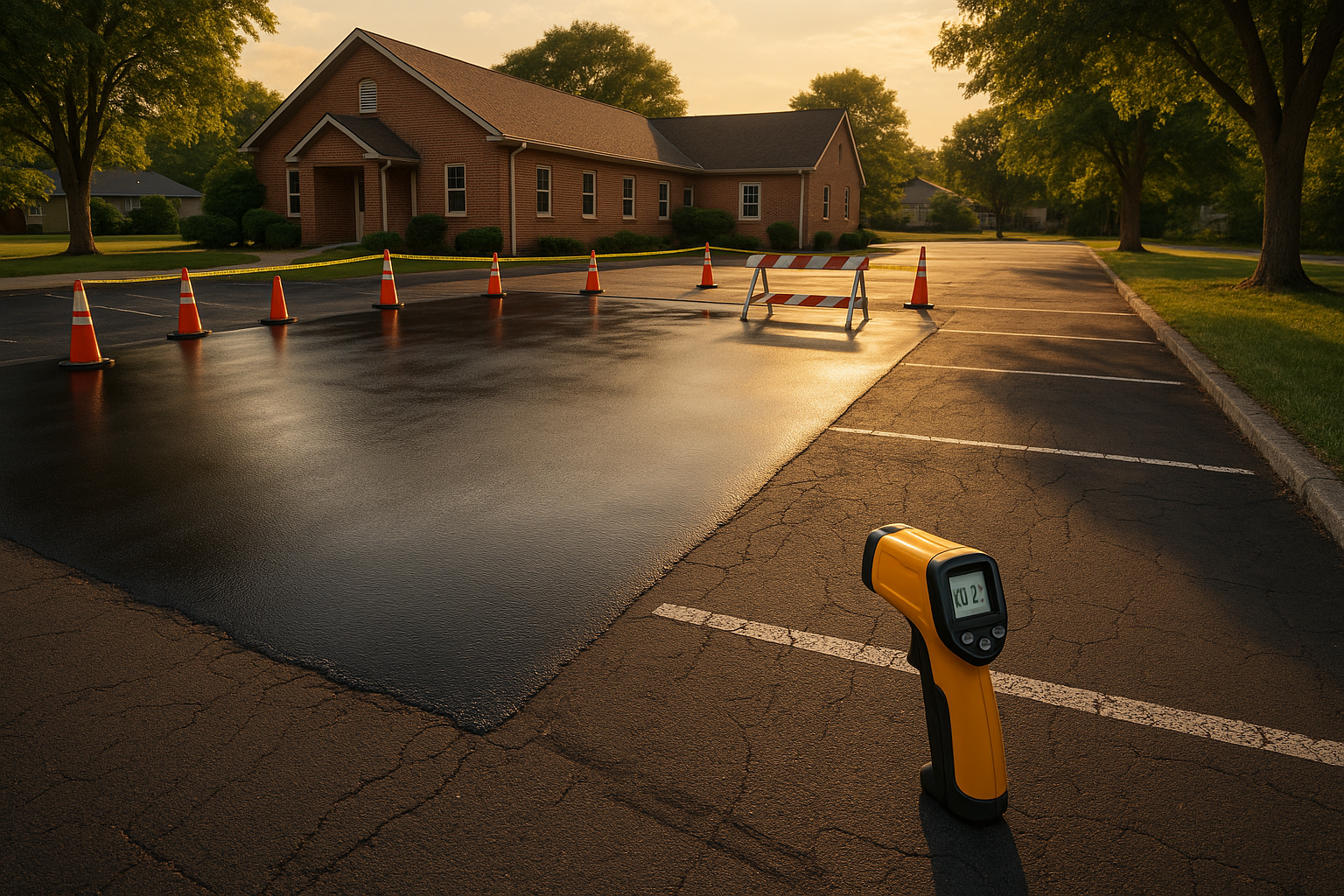
Prime sealcoating season here is April through October. Spring can be tricky with those overnight lows and morning dew. If we apply at 2 p.m. and the sun hits it for six hours, we’re golden. But a 6 p.m. finish in April? That sealer might still be soft by morning because of dew. Fall brings its own issues. By mid-October, nighttime temps in Brownsburg or Avon can dip into the 40s, and cure times slow way down. We always check pavement temps with a gun. If it’s under 50, we reschedule.
Winter prep is another reason to get your sealcoating done early. A properly cured lot stands up to freeze-thaw cycles and plow blades way better. Prepping for winter is a whole other conversation, but it ties directly into why cure time matters.
How We Know It’s Ready
We don’t just look at the clock. We use a few old-school tests:
- Touch test: Press a finger into a shaded area. If it’s tacky, wait.
- Twist test: Twist your shoe on it. If it leaves a dark smudge, it’s not ready for tires.
- Tape test: Press tape on the surface and pull. If sealer comes with it, striping will fail.
We’ve been doing this long enough to know that every lot in Indianapolis has its own rhythm. A south-facing lot in Fishers might be ready in 22 hours; a shaded lot near the White River might need 30.
Our Promise (Without the Salesy Stuff)
When you call PavementPros about sealcoating and striping, we don’t hand you a generic schedule. We walk the lot. We check the sun, the shade, the drainage, the way cars actually move. We factor in your business hours, your upcoming events, and the forecast. Then we hand you a clear plan with realistic closings and a phased map if you need it.
If you’re managing a commercial property in Indianapolis, Carmel, Fishers, Zionsville, or anywhere in the metro, let’s talk. We’ll answer the real question—how long sealcoat take to dry on your lot—and build a timeline that keeps your parking safe and your blood pressure low. No obligation, just a straight conversation. Grab a time for a free site walk.
Ready for a free lot assessment?
We walk the lot, photograph the problems, and hand you a written plan — no pressure, no obligation.