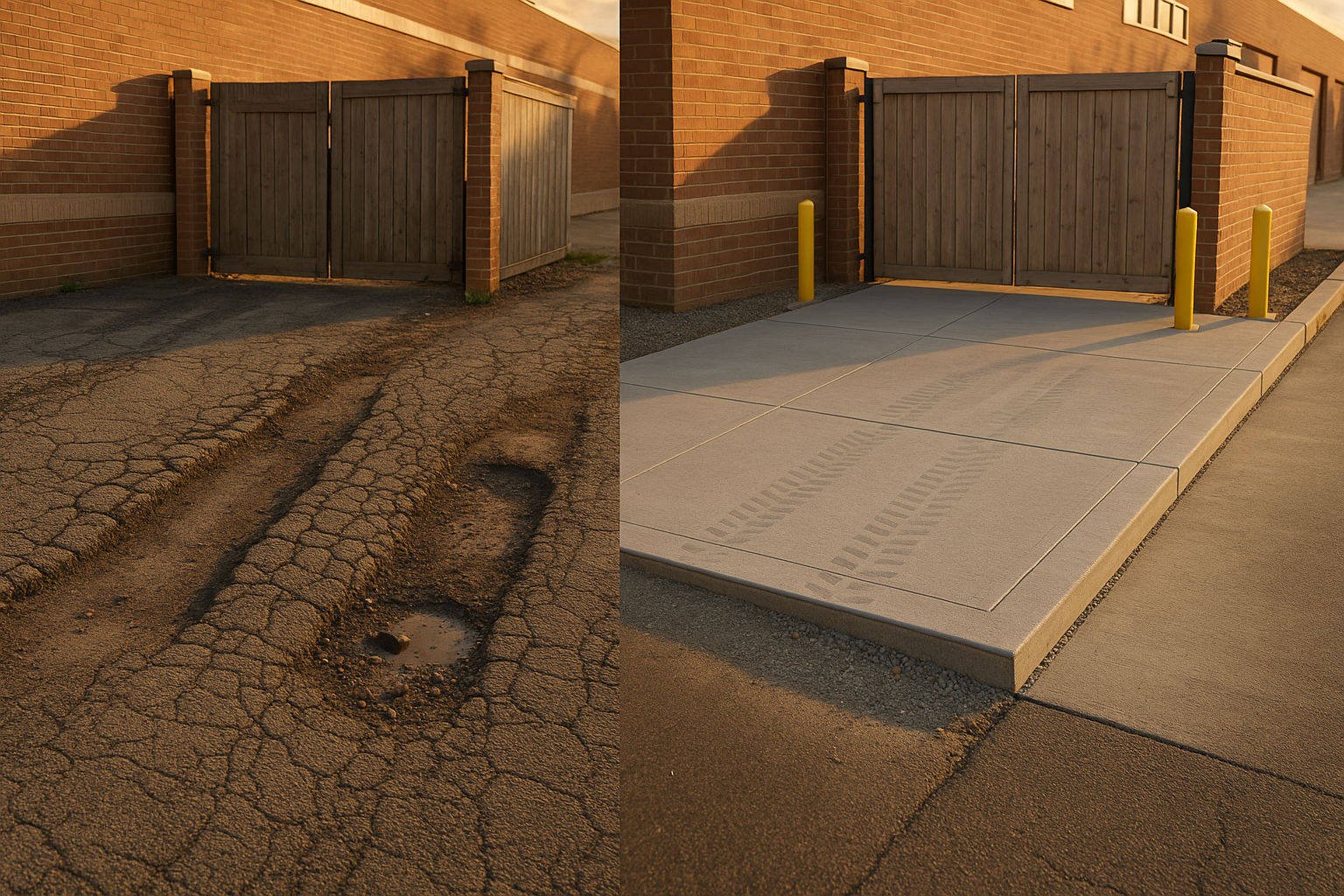
A buddy of mine manages a strip mall off 86th Street in Indianapolis. Last summer, his main trash enclosure went from okay to awful in a matter of months. The asphalt in front of the dumpster was rutted, cracked, and sinking. The hauler started refusing to pick up because the front wheels of the truck were sinking into the soft spots. He tried patching, but every time the truck lifted the dumpster and slammed it down, the patch crumbled. Then winter came, and the freeze-thaw cycles turned those cracks into craters. Sound familiar? That's why we tell people that if you're doing dumpster pad installation, skip the asphalt and go concrete from the start.
Why Asphalt Fails Around Dumpsters
Asphalt is great for parking lots where loads spread out. But a front-load dumpster truck can weigh 50,000 pounds loaded, and all that weight concentrates on small wheel contact patches when the truck pulls up to the enclosure. Then the driver lifts the dumpster, backs up, and turns — the wheels twist and grind on the same spot. Add in the weight of the dumpster slamming down after being lifted, and you've got point loads that asphalt just isn't built to handle. In Indianapolis, freeze-thaw cycles make it worse. Water seeps into tiny cracks, freezes, expands, and breaks the pavement from the inside. Before you know it, the pad is rutted, cracked, and full of potholes. Asphalt also softens in the summer heat, and diesel or garbage juice eating away at the binder doesn't help. A concrete dumpster pad will hold up under those same loads for decades. That's why any honest contractor will tell you asphalt belongs in the parking lot, not under a dumpster. (If you want to compare asphalt thickness for other areas, check out our piece on asphalt paving thickness for commercial lots.)
What a Concrete Dumpster Pad Should Include
When we spec a dumpster pad installation in the Indianapolis area, here's what we recommend. Start with a 6 to 8 inch thick reinforced concrete slab. For front-load trucks, we usually go 8 inches because the point loads are brutal. The concrete should be 4000 to 5000 psi and air-entrained for freeze-thaw durability. Inside, we lay a #4 rebar grid at 12 inches on center each way — that's what gives the slab tensile strength so it doesn't crack under bending. Under the concrete, you need a 6 to 8 inch compacted aggregate base, usually CA-6 or #53 stone, packed in lifts to 95% or better density. On clay soils, throw down a geotextile fabric to keep the stone from mixing with the dirt. The pad should slope 1 to 2 percent so water drains away, not into the enclosure or against the building. Sawcut control joints every 8 to 10 feet let the concrete crack where we want it to, not randomly. A broom finish gives the hauler's wheels some grip. And the front edge where the dumpster gets dragged — we thicken that edge and often add a steel angle or armored edge. Dowel into any adjacent pavement so the pad doesn't settle independently and create a lip.
Subgrade and Clay Soils in Central Indiana
If you've ever dug a hole in this part of the state, you know the soil: sticky, heavy clay that shrinks and swells with moisture. That clay can play hell with a dumpster pad if you don't prep the subgrade right. We always proof-roll the area with a loaded truck or a roller to find soft spots. If we find any, we dig them out and fill with compacted stone. On worse sites, a geotextile underlayment separates the clay from the aggregate so the stone doesn't sink into the mud over time. This step adds a little cost, but it's way cheaper than tearing out a cracked pad two years later. We've seen pads fail because someone skipped the base work — the front edge sinks, the hauler's truck scrapes, and suddenly you're redoing the whole thing. For a deeper look at when and why to use geotextile fabric, read our post on geotextile fabric and asphalt base stabilization.
Hauler Specs and Tight Access
Before you pour anything, get the specs from your waste company. Republic Services, Waste Management, and Ray's Trash all have their own container sizes and truck axle loads. A pad sized for a 2-yard dumpster won't cut it for a 6-yard or a trash compactor. We always ask for the hauler's wheel spacing and turning radius, then design the apron to match. Tight access is common in older parts of town — think Broad Ripple, Fountain Square, or Speedway where alleys are narrow and buildings sit close together. You might need a longer apron or a different turning geometry so the truck can get in and out without jumping the curb. We also install steel bollards at the gate posts and enclosure corners to protect the pad and the building from wayward trucks. Nobody wants a front-load truck clipping the corner of a brick building because the turning radius was too tight.
Cold Weather and Cure Times
Winter in central Indiana is hard on concrete. Freeze-thaw cycles and deicing salts will chew up a bad mix in one season. That's why we always use air-entrained concrete with 4000 to 5000 psi. Air entrainment gives the concrete microscopic air bubbles that act like pressure relief valves when water freezes. If you're pouring in late fall or winter, we can use insulated curing blankets and accelerator admixtures to keep the concrete warm enough to cure properly. But here's the thing: you can't rush the cure. A dumpster pad needs at least 7 days before you set a dumpster on it, and 28 days before it reaches full design strength for heavy truck traffic. We've had managers ask us to speed that up, but putting a front-load truck on a 3-day-old pad is a recipe for cracking. Coordinate with your hauler to schedule pickup elsewhere for a week or two, or stage a temporary dumpster on a protected area. It's worth the wait.
Maintenance and the First Year
A concrete pad isn't completely maintenance-free, but it's close. Keep the sawcut joints sealed to keep water out — that's the biggest thing. Seal them right after the concrete cures and then check them every couple of years. Redirect any downspouts or roof drains away from the pad so water isn't constantly saturating the subgrade. And be careful with snowplows. We see plow blades chip and gouge the leading edge of dumpster pads every winter. Ask your plow contractor to lift the blade at the pad, or we can install an armored edge that takes the hits better. Also, avoid heavy deicing salts in the first winter — the concrete is still gaining strength and salts can cause surface scaling. (We wrote a whole post on snow plow damage to striping and curbs that covers some of this.)
Get a Stamped Scope and a Real Quote
If your dumpster pad is failing, don't keep throwing asphalt patches at it. The only long-term fix is a properly designed concrete dumpster pad installation. At PavementPros, we start every project with an on-site assessment. We measure the area, check the soil, talk to your hauler, and put together a stamped scope of work with a written quote. No hidden fees, no vague line items. Call us or hit the link to schedule a free site walk and quote. We work all over Indianapolis, Carmel, Fishers, Zionsville, Westfield, Noblesville, Greenwood, Brownsburg, Avon, and Plainfield, so we know the local soil and weather. Let's get your dumpster area fixed right the first time.
Ready for a free lot assessment?
We walk the lot, photograph the problems, and hand you a written plan — no pressure, no obligation.