Last spring, my brother-in-law in Fishers spent a Saturday hunched over his driveway with a few tubes of hardware-store crack filler. He’d watched a couple videos, felt pretty confident. An hour in, the cracks were half-filled, sticky, and already collecting dirt. By July, those same cracks had opened right back up. He was out $60 and a whole afternoon, but more than that, he was frustrated. Sound familiar? You’re not alone. Driveway cracks are a rite of passage for Indianapolis homeowners. But before you grab another tube, let’s talk about what actually holds up here—and when it’s smarter to hand it off.
Why Your Indianapolis Driveway Cracks
Our climate is rough on asphalt. Central Indiana gets dozens of freeze-thaw cycles every winter. Water sneaks into tiny gaps, freezes, expands, and pries those gaps wider. Then spring thaw lets the pavement settle back, but the crack is already permanent. Add de-icing salts that eat away at the binder, snowplow scrape lines along the edges, and heavy clay soil that shifts with moisture, and you’ve got a recipe for cracks from Carmel to Greenwood.
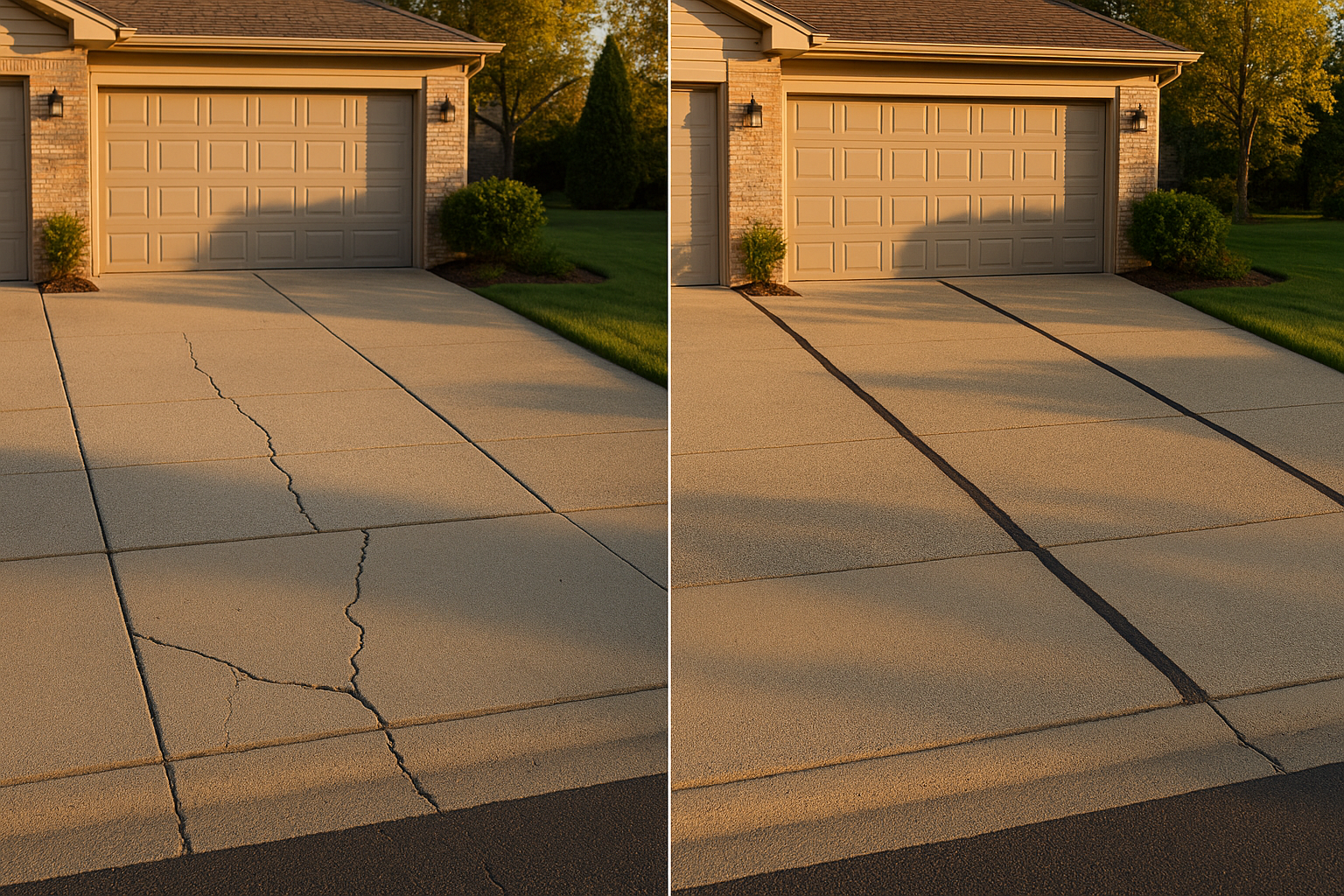
I’ve heard it from homeowners in Zionsville and Brownsburg: one winter the driveway looks fine, the next it’s laced with lines like a roadmap. Edge cracks near the garage apron are especially common where asphalt meets concrete—that joint takes a beating from both frost heave and tire traffic.
What Can You Actually Fix With Driveway Crack Filler?
Not every crack is the same. A narrow, straight crack—say, up to about half an inch wide—is usually a good candidate for crack filler. These linear cracks are caused by surface tension and age. Fill them right, and you stop water from getting underneath.
But if you’ve got a spiderweb of small cracks, sometimes called alligator cracking, that’s a different animal. That usually means the base under the asphalt is failing. No amount of filler will fix that. You’d need a patch or even a full-depth repair. Same with big depressions or edges that crumble when you poke them. If you’re unsure, it’s worth having someone look. We’ve got a whole article on signs of subgrade failure under asphalt that might help you decide.
Crack filling, crack sealing, and patching all get tossed around like synonyms, but they’re different. Filling is for smaller, stable cracks—you fill the void to keep water out. Sealing is a more involved process with routing and flexible rubber. Patching is for chunks of pavement that are actually broken out. For most residential driveways in Indianapolis, crack filling (or sealing for wider joints) is the sweet spot.
Still, the type of crack filler you use makes a huge difference.
Hot Pour vs Cold Pour: The Real Difference
Hardware store tubes are cold pour. They’re convenient, but they cure rigid. In freeze-thaw country, rigid filler cracks right along with your driveway. That’s why pros use hot-pour rubberized crack sealant. It’s heated to around 400°F and applied as a liquid that stays flexible for years. It moves with the asphalt instead of fighting it.
Cold pour has its place—maybe for a hairline crack in a low-traffic corner. But for anything wider than a quarter inch, or any crack that sees vehicle traffic, hot rubber is the way to go. You’ll hear it called hot rubber crack fill, and it’s the standard for long-term asphalt crack repair in Indianapolis.
In my experience, homeowners save a little money with cold pour and then pay for it again in a year. If you’re going to do it yourself, at least understand the trade-off.
The DIY Route: Hardware Store Tubes and Hopeful Thinking
Look, I get the appeal. A tube costs $10–15. Hiring a pro starts at a few hundred. For a single hairline crack, DIY might be fine. But here’s what usually goes wrong: folks don’t clean the crack out properly. If there’s dust, debris, or moisture in there, the filler won’t stick. Then they overfill, leaving a raised blob that looks messy and gets scraped by tires. Or they do it on a 45°F day in November when the crack is damp and the filler never cures.
One homeowner in Avon told me she filled her cracks in the fall, and by spring the filler had popped out in one long string like a rubber band. The problem? She’d skipped the cleaning and the crack was wet underneath. So she wasted an afternoon and still had the same cracks.
If you’re determined to DIY, at least do these: blow out the crack with compressed air or a leaf blower, make sure it’s bone dry, fill it level with the surface, and do it when the pavement is warm and no rain is forecast for 24 hours. But for multiple cracks, wider cracks, or anything near the garage where appearance matters, a pro saves you the headache.
Why a Pro’s Prep Work Matters
When we show up to fill driveway cracks, we don’t just squirt goo in a line. Prep is everything. Sometimes we rout the crack first—that means using a machine to cut a clean, slightly wider channel so the sealant has more surface to grip. Then we blow it out, sometimes heat-lance it to remove any moisture, and only then apply hot-pour rubber. We band the sealant a little wider than the crack, then dust it lightly with sand so you can walk on it without tracking black marks. That sand also helps the fill blend in with the pavement after sealing.
This kind of prep is why pro crack filling lasts 5–7 years in Indiana, while a tube job might last one season. It also prevents water from getting underneath, which is the whole point. Because once water gets down there and freezes, you’re looking at potholes and base damage—much more expensive than crack filler.
When to Schedule in Indiana
You can’t fill cracks year-round. The sweet spot is spring through fall, when daytime temps are between 50°F and 85°F and the pavement is dry. Early spring after the thaw is popular because everyone sees the damage. But if you wait until late May, the weather’s more predictable. Late summer and early fall are also great—just avoid the leaf drop in late October; leaves and pollen in the cracks ruin adhesion.
We always watch the forecast. If there’s rain coming within 12–24 hours, we reschedule. Hot-pour sealant cures fast, but it needs dry pavement to bond.
And yes, we get asked: “Will it just crack again after winter?” If done right, the filled crack stays sealed. But new cracks can form elsewhere—it’s ongoing maintenance. That’s why pairing crack filling with sealcoating every 2–3 years is the best defense. We wrote about that schedule in detail over at how often to seal a driveway in Indiana.
Cost and Value: What You’re Actually Paying For
So what does it cost to fill driveway cracks? It’s usually priced by the linear foot, with factors like crack width, number of cracks, whether routing is needed, and how accessible your driveway is. A typical Indianapolis driveway with a handful of linear cracks might run $200–$500. That’s not pocket change, but compare it to the $2,000+ you’d spend on a full driveway patch or replacement if water destroys the base.
I’ve seen homeowners in Noblesville ignore cracks for a couple years, then suddenly they’ve got a pothole at the garage apron. Now they’re patching and praying. Filling cracks early is pavement preservation—it’s the same idea as changing your oil instead of replacing your engine. We covered this more in our article on pavement preservation vs rehabilitation.
And here’s the thing: you’re not just paying for material. You’re paying for someone who knows the difference between a fillable crack and a base failure, who has a hot kettle and a router, and who won’t leave a sticky mess on your pavers.
The PavementPros Approach
At PavementPros, we start with a quick site visit. We’ll walk the driveway with you, map out every crack, and tell you straight up what needs filling, what needs more, and what can wait. No pressure, no scary tactics. We use premium hot-pour rubber, keep the work area tidy, and dust everything with sand so it looks clean. We service homes all around the Indy metro—Indianapolis, Carmel, Fishers, Zionsville, Westfield, Noblesville, Greenwood, Brownsburg, Avon, Plainfield.
If you’re tired of playing whack-a-mole with hardware store tubes, request a no-commitment driveway assessment. We’ll give you a clear scope, a fair price, and a window that works with your schedule. Your driveway will thank you next winter.
Ready for a free lot assessment?
We walk the lot, photograph the problems, and hand you a written plan — no pressure, no obligation.