I texted my buddy Dave last March. He'd just spent his Saturday staring at the cracks in his driveway in Broad Ripple. "Is it worth resurfacing, or can I just sealcoat this thing and call it a day?" He's not alone. Every spring I hear from homeowners in Carmel, Fishers, and Irvington who want to know the real difference between driveway resurfacing cost and a cheap sealcoat. And honestly, the answer usually comes down to what's underneath the surface.
What Resurfacing Actually Is (And Why It's Not Just a Thick Sealcoat)
Resurfacing, also called an asphalt overlay, means grinding down the top layer a bit and then laying a fresh 1.5 to 2 inches of new asphalt right over the existing driveway. It's like putting a new top on an old table, not just polishing it. A sealcoat, on the other hand, is a thin protective coating — think of it as sunscreen for your asphalt. It seals small cracks and blocks UV rays and water, but it doesn't add any strength. If your driveway has alligator cracking, potholes, or deep ruts, sealcoating is like putting a band-aid on a broken bone. That's where resurfacing comes in.
What Does Driveway Resurfacing Cost in Indianapolis?
Let's get to the numbers. A typical 2–3 car driveway in the Indy metro runs 600 to 1,200 square feet. For resurfacing (an asphalt overlay), you're looking at about $3.50 to $7.00 per square foot. So for an 800-square-foot driveway, that's roughly $2,800 to $5,600. Sealcoating costs much less: $0.20 to $0.45 per square foot, so that same driveway might only need $160 to $360 for a two-coat sealcoat. If you've got cracks, hot rubber crack filling runs $1 to $3 per linear foot. And localized patching (for potholes or big broken spots) adds $8 to $15 per square foot as needed. These are central Indiana price ranges, not quotes, but they give you a ballpark.
I've heard from enough homeowners to know that the driveway resurfacing cost can vary a lot depending on a few things:
- Driveway size and shape (obvious, but worth saying).
- How thick the overlay needs to be. Standard residential overlays are 1.5 to 2 inches, and that thickness matters. You can read more about asphalt overlay thickness on our blog.
- Base condition. If the gravel base underneath is shot, you might need spot base repair before resurfacing. That adds cost, but skipping it means the new overlay fails fast. We've had to explain this to homeowners in Zionsville and Greenwood whose driveways settled because of clay soil heaving.
- Crack density and patching. The more prep work (cleaning, crack filling, patching), the higher the total. Hot rubber crack fill is cheap insurance before an overlay.
- Drainage corrections. If water pools near the garage or downspouts dump onto the asphalt, you might need to adjust grading or add a channel drain. That's separate from the overlay itself.
- Edges and transitions. If your driveway meets a concrete garage apron or sidewalk, the crew may need to mill or feather the edge to avoid a lip. That's a common request in older neighborhoods like Meridian-Kessler.
Resurface vs Sealcoat: How to Decide
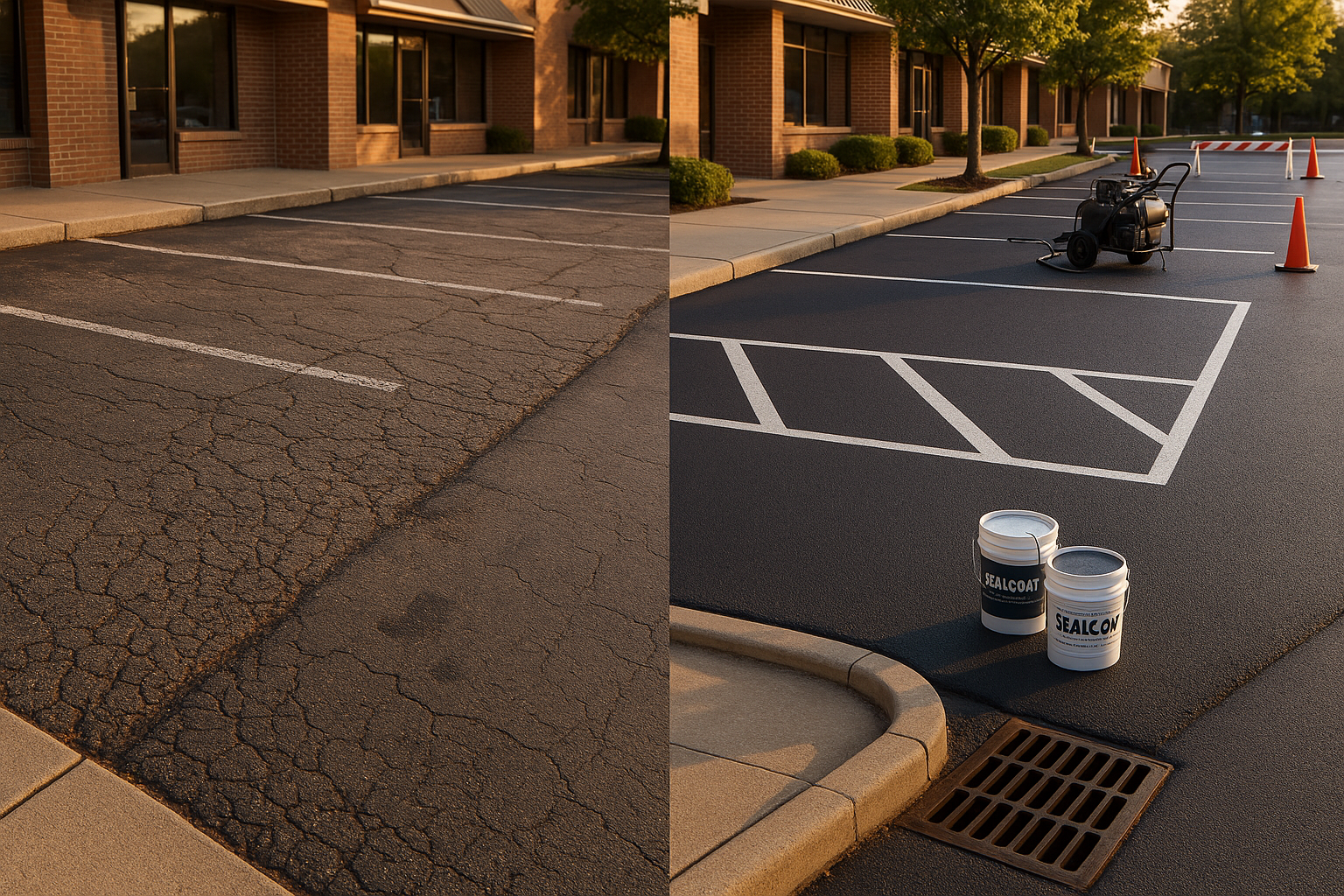
Here's my rule of thumb: if your asphalt is oxidized and has some small cracks but the structure is still solid, sealcoating is fine. It'll buy you a few more years and protect against freeze-thaw damage. Sealcoating every 2–3 years is the cheapest way to keep a healthy driveway alive. Check out this post on how long a sealcoat actually lasts for real-world numbers.
But if you see alligator cracking (those interconnected cracks that look like a reptile's back), potholes, or ruts where tires sit, you need resurfacing. Resurfacing fixes the surface, not the base — but if the base is okay, it's a fraction of the cost of full replacement. And it can add 15–20 years to your driveway with proper maintenance. We did a resurfacing job last fall in Avon where the homeowner had been sealcoating every year for a decade, but the alligator cracks kept spreading. The overlay stopped them cold. He told me he wished he'd done it five years earlier instead of throwing money at sealers.
Why Thickness and Quality Materials Matter
A 1.5-inch overlay is the minimum we recommend for residential driveways in central Indiana. Anything thinner doesn't have enough structural strength to bridge minor base imperfections and can crack prematurely. We use hot-applied rubber for crack filling (not cold-pour junk from the hardware store) because it flexes with temperature swings. And for sealcoating, we use polymer-modified sealer that holds up better against road salt and snowplow scrapes. If you're wondering about DIY crack filling, I wrote a comparison of DIY vs professional crack filling that might save you some headaches.
The freeze-thaw cycle here is brutal. Water gets into a tiny crack, freezes, expands, and pries the crack wider. Then salt gets in and eats away at the asphalt binder. That's why regular maintenance after resurfacing is key. Sealcoat every 2–3 years, fill cracks as soon as they appear, and your overlay will live long past the warranty. How often to seal a driveway in Indiana is a whole topic on its own.
Timing Your Project in Indy
Asphalt plants in the Indy metro typically run from late spring through late fall, depending on temperature. You want daytime temps above 50°F and dry weather for proper compaction. That means May through October is prime time. If you schedule too early in spring or too late in fall, you risk a crew rushing in cold rain, and the asphalt won't set right. We've had to push jobs back a week because of an April cold snap. That's normal.
After resurfacing, you can usually walk on the driveway after a few hours and drive on it after 24–48 hours, but wait a few days before heavy vehicles or turning tires. Cooler weather extends cure time. With sealcoating, wait at least 24 hours before walking and 48 hours before parking. I know it's annoying, especially when you're used to pulling right into the garage. But it's worth it.
Common Questions I Hear from Homeowners
"Won't an overlay create a lip at my garage or sidewalk?" Not if it's done right. We mill the existing asphalt at transitions and use a tapered edge so the new surface meets flush. If your driveway slopes toward the house, we might need to adjust drainage first. That's part of the site assessment.
"What if my base is bad?" That's why we sometimes suggest a pavement core sample to see what's underneath. If the base is gravel and it's still stable, resurfacing works. If the base is mud and heaving from clay soil, you might need spot base repair before the overlay. It's not cheap, but it's cheaper than full replacement.
"Can you work with my HOA?" Absolutely. Neighborhoods like Geist, Carmel, and Fishers often have appearance guidelines and work-hour restrictions. We'll communicate with your HOA if needed and keep the site clean — protecting adjacent pavers, concrete, and landscaping.
Get a Straight Answer, Not a Sales Pitch
Look, I've been doing pavement work in Indianapolis long enough to know that nobody wants to overspend. So here's what we do: we come out, walk your driveway, take measurements and photos, and give you a written scope with line-item options. If sealcoating will honestly get you by for a few more years, we'll tell you that. If you need resurfacing, we'll show you why and what it'll cost. No pressure, no hidden fees.
If you're still on the fence, snap a few photos of your driveway and send them over. We can give you a rough idea before we even schedule a visit. Or if you're ready for a proper on-site assessment and written quote, request one here. Your driveway takes a beating every Indiana winter — let's make sure it's ready for the next one.
Ready for a free lot assessment?
We walk the lot, photograph the problems, and hand you a written plan — no pressure, no obligation.